
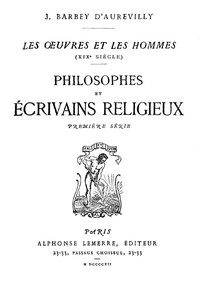
Philosophes et Écrivains Religieux by J. Barbey d'Aurevilly
Let's be clear: this isn't a novel with a plot. Philosophes et Écrivains Religieux is a collection of Barbey d'Aurevilly's critical essays. Think of it as a series of intense, opinionated conversations captured on paper. He writes about other writers—some famous, some forgotten—but he's really using them to stage a much bigger argument.
The Story
There's no traditional story, but there is a powerful through-line: the clash of two worlds. On one side, Barbey examines the 'philosophes'—the thinkers of the Enlightenment and their 19th-century heirs who championed reason, science, and progress. On the other, he champions the 'religious writers'—those who, like him, believed in faith, tradition, and the mysteries of the soul. Each essay is a portrait and a judgment. He dissects their ideas with a surgeon's precision and a duelist's flair, praising what he loves and skewering what he sees as hollow or dangerous. The 'plot' is the drama of his own fierce mind wrestling with the ideas that were reshaping France.
Why You Should Read It
You read this for the voice. Barbey d'Aurevilly is not a neutral observer; he's a participant, a defender of a cause. His prose crackles with energy, sarcasm, and deep conviction. Even when I disagreed with him (which was often), I couldn't stop reading. He makes literary criticism feel urgent and alive. It's less about dry analysis and more about watching a brilliant, temperamental artist explain why certain ideas matter, why some books are spiritual nourishment, and why others are poison. You get a stunningly clear picture of the intellectual battles of his time, filtered through a unique and uncompromising personality.
Final Verdict
This book is perfect for readers who love strong personalities and intellectual history with a punch. If you enjoy essays by writers like Gore Vidal or Christopher Hitchens—people who argue with style and fire—you'll find a kindred spirit in Barbey, even if he's coming from the opposite political and religious direction. It's also a great pick for anyone curious about 19th-century French thought beyond the usual novelists. Be warned: it demands your attention. But if you're up for a challenging, provocative, and utterly singular ride through one critic's passionate worldview, it's incredibly rewarding.
This publication is available for unrestricted use. Knowledge should be free and accessible.
William Smith
4 months agoGreat value and very well written.
Richard Perez
1 month agoI found the author's tone to be very professional yet accessible, the concise summaries at the end of each section are a lifesaver. It definitely lives up to the reputation of the publisher.
Donald Johnson
10 months agoI've been looking for a reliable source on this topic, and the author’s unique perspective adds a fresh layer to the discussion. Simple, effective, and authoritative – what else could you ask for?
Linda Jones
1 month agoI appreciate the objective tone and the evidence-based approach.




Linda Davis
8 months agoSolid information without the usual fluff.